

How to Choose a Good Mortgage Lender in Utah
The best mortgage lender for a Utah buyer is the one that is properly licensed, quotes the lowest total cost on a like-for-like basis, and closes on time. Rate is only one piece of that. Fees, loan programs, and how well the lender communicates can change what you pay and whether your offer survives.
This guide walks through how to compare lenders step by step, with Utah-specific resources along the way.
1. Know the types of lenders
Utah buyers can borrow from several kinds of lenders, and each has a different strength.
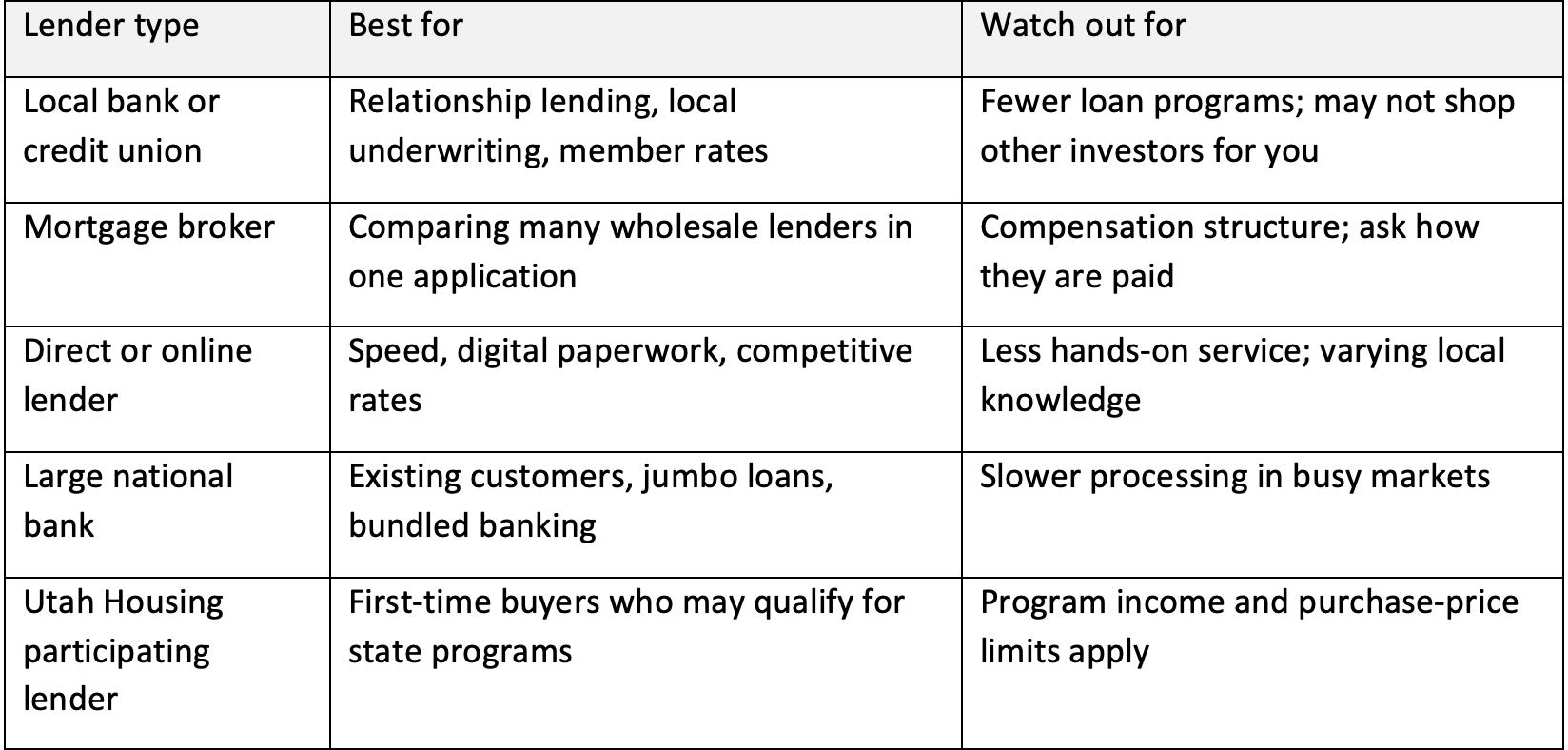
Get quotes from at least one lender in two different categories. The gap between them is often where the savings are.
2. Verify the license and reputation
In Utah, the Division of Real Estate licenses mortgage loan originators, mortgage companies, branches, and lending managers. Check any lender before you share documents or pay for an appraisal.
1. Ask for the loan officer's NMLS number. It should be on their email signature, website, and business card.
2. Look up the individual and the company on NMLS Consumer Access, the free national lookup.
3. Review the Utah Division of Real Estate mortgage page for licensing information and its disciplinary actions list.
4. Read recent reviews, and weigh the pattern of comments over any single story. Look for comments about communication and closing on time.
5. Ask your real estate agent who they trust. Agents see which lenders close on time and which ones cause delays.
If something goes wrong, the Division accepts complaints through its online form or by phone at (801) 530-6747.
3. Compare total cost, not just the rate
Requesting offers from several lenders can pay off: the CFPB says homebuyers can potentially save $600 to $1,200 per year by getting offers from multiple lenders, citing Freddie Mac research (CFPB).
How to compare fairly:
• Apply with several lenders in a short window. Multiple mortgage credit checks within 45 days are recorded as a single inquiry on your credit report, according to the CFPB.
• Ask for a Loan Estimate from each. Once you give a lender six key pieces of information, it must send a Loan Estimate within three business days.
• Match the loan. Compare the same loan type, term, and down payment, and confirm whether the rate is locked.
• Look past the interest rate. Compare the APR, discount points, origination and underwriting fees, and the total closing costs.
• Check the risky terms. Look for a prepayment penalty, a balloon payment, or a payment that can rise after closing.
• Read for errors. Check your name, the property address, and the loan amount.
Lenders will often match or improve an offer when you show them a competing Loan Estimate, so use it to negotiate.
4. Ask about Utah loan and assistance programs
Utah Housing Corporation offers programs for low-to-moderate-income Utah buyers, including a First-time Homebuyer Assistance Program, Deferred Down Payment Assistance, and up to $20,000 toward a newly built home for first-time buyers. Funds on new construction can go toward the down payment, closing costs, or a permanent rate buydown.
To use these programs, you start with one of its approved participating lenders, so ask each lender up front whether they participate. Income and purchase price limits apply, and program funds are limited, so confirm current availability before you count on it.
Also ask each lender whether they offer the federal programs that may fit your situation: FHA, VA, and USDA loans. A lender that does not offer a program you qualify for cannot compare it for you.
5. Judge service and speed
A low rate means little if the loan does not close by the date in your contract. Test the lender's service before you commit.
• Responsiveness. Note how fast they return calls and emails during the quoting stage. It rarely improves after you apply.
• Clear answers. A good loan officer explains fees in plain words and tells you what documents they will need and when.
• Closing timeline. Ask how many days they typically take from application to closing, and what they do to hit a contract deadline.
• Local underwriting. Ask whether underwriting is handled in-house or by an outside team, and who you will contact if there is a problem.
• Pre-approval strength. Ask for a full pre-approval with documents reviewed, not a quick pre-qualification. Sellers take it more seriously, which helps in a competitive offer.
6. Questions to ask every lender
• ☐ What is your NMLS number, and the company's?
• ☐ Which loan programs do you offer, including FHA, VA, USDA, and Utah Housing programs?
• ☐ Is this rate locked, and for how many days? What does an extension cost?
• ☐ What are your total lender fees, and which of them can change?
• ☐ Are discount points included in this quote? What do they buy me?
• ☐ How long do you typically take to close, and who underwrites the loan?
• ☐ Who will be my contact, and how do I reach them on evenings and weekends?
• ☐ Is there a prepayment penalty?
• ☐ Will you sell or transfer my loan servicing after closing?
7. Red flags to walk away from
• No NMLS number, or one that does not match their name on NMLS Consumer Access.
• A rate quoted with no Loan Estimate, or a Loan Estimate they will not provide in writing.
• Pressure to lock or apply immediately, or a promise that sounds too good compared with every other quote.
• Refusing to explain a fee, or fees that change without explanation between quotes.
• A request to sign blank or incomplete forms.
• Difficulty reaching them before you apply.
Next steps
Pick three lenders in at least two categories, and verify each one on NMLS Consumer Access. Request Loan Estimates from all three within the same few days so your credit inquiries count as one. Then compare the total cost and service side by side, and choose the lender that is the best overall.
I can send you recommendations of mortgage lenders I have worked with who have helped my clients qualify for and buy a home. I can also give you names of lenders for land purchases.
This article is general information, not financial advice. Rates, fees, and program rules change often, so confirm current details with each lender.
Sources
• CFPB: Request and review multiple Loan Estimates